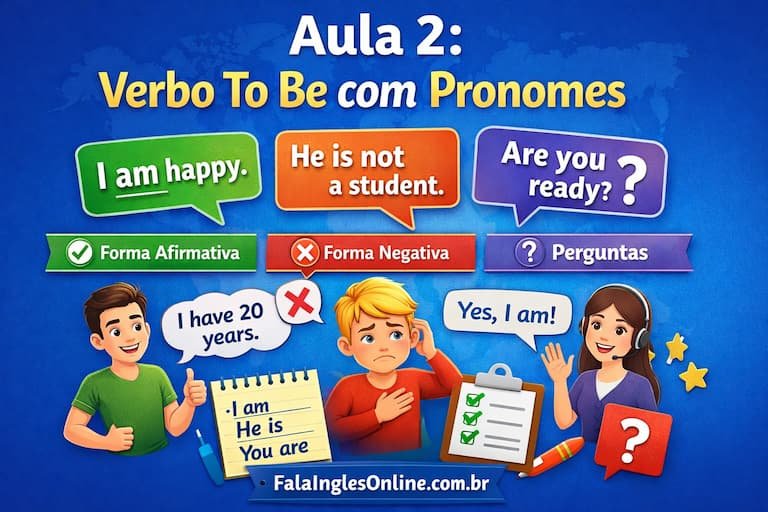
🎯 Objetivo da Aula
Ao final desta aula, você será capaz de:
-
Usar o verbo to be com os pronomes (I, you, he, she, it, we, they)
-
Formar frases afirmativas, negativas e perguntas corretamente
-
Responder perguntas com short answers (respostas curtas)
-
Evitar erros comuns de brasileiros (ex.: “I have 20 years”, “I am have”, “She don’t”)
📌 O que é o verbo “to be”?
O to be é um dos verbos mais importantes do inglês. Ele pode significar:
-
ser (I am a student = Eu sou estudante)
-
estar (I am tired = Eu estou cansado)
E aparece o tempo todo em frases básicas: identidade, profissão, sentimentos, idade (em inglês!), localização, clima e muito mais.
🧠 Conjugação do To Be no Presente
No presente, o verbo “to be” tem 3 formas:
-
am (para I)
-
are (para you / we / they)
-
is (para he / she / it)
✅ Tabela To Be + Pronomes
-
I am
-
You are
-
He is
-
She is
-
It is
-
We are
-
They are
✅ 1) Forma Afirmativa (Affirmative)
Estrutura:
Sujeito + to be + complemento
Exemplos:
-
I am Brazilian.
-
You are my friend.
-
He is a teacher.
-
She is happy.
-
It is cold today.
-
We are students.
-
They are at home.
⚠️ Erro comum:
❌ She happy.
✅ She is happy.
Em inglês, você precisa do verbo.
✅ 2) Contrações (Contractions) — Inglês real
Na vida real, as pessoas quase sempre usam contrações.
Contrações com am
-
I am → I’m
Ex.: I’m tired. / I’m ready.
Contrações com is
-
He is → He’s
-
She is → She’s
-
It is → It’s
Ex.: He’s my brother. / It’s cold.
Contrações com are
-
You are → You’re
-
We are → We’re
-
They are → They’re
Ex.: You’re my friend. / They’re here.
⚠️ Atenção importante (muito comum):
It’s = It is
Its = possessivo (its name = o nome dele/dela — de coisa/animal)
✅ 3) Forma Negativa (Negative)
Para negar no to be, basta adicionar not:
-
I am not
-
You are not
-
He is not
-
She is not
-
It is not
-
We are not
-
They are not
Exemplos:
-
I am not sad.
-
You are not late.
-
He is not a doctor.
-
She is not tired.
-
It is not hot today.
-
We are not ready.
-
They are not at home.
Contrações negativas (muito usadas)
-
is not → isn’t
-
are not → aren’t
Ex.: He isn’t here. / They aren’t ready.
⚠️ Atenção:
“I amn’t” não existe.
Para I am not, usamos:
-
I’m not (mais comum)
✅ 4) Perguntas (Questions) com To Be
A grande regra:
✅ Para fazer pergunta com “to be”, você inverte:
To be + sujeito + complemento?
Exemplos:
-
Are you okay?
-
Is he your teacher?
-
Is she Brazilian?
-
Is it raining?
-
Are we late?
-
Are they friends?
⚠️ Erro comum:
❌ You are happy? (isso é frase afirmativa com interrogação, não é o padrão)
✅ Are you happy?
✅ 5) Short Answers (Respostas Curtas)
Em inglês, a forma natural de responder sim/não é com short answers:
Yes
-
Yes, I am.
-
Yes, you are.
-
Yes, he is.
-
Yes, she is.
-
Yes, it is.
-
Yes, we are.
-
Yes, they are.
No
-
No, I’m not.
-
No, you aren’t.
-
No, he isn’t.
-
No, she isn’t.
-
No, it isn’t.
-
No, we aren’t.
-
No, they aren’t.
Exemplo:
A: Are you a student?
B: Yes, I am. / No, I’m not.
✅ 6) Frases muito úteis com To Be (iniciante)
Essas frases aparecem o tempo todo:
-
I’m fine. (Estou bem.)
-
I’m tired. (Estou cansado.)
-
I’m hungry. (Estou com fome.)
-
I’m thirsty. (Estou com sede.)
-
I’m busy. (Estou ocupado.)
-
I’m ready. (Estou pronto.)
-
It’s hot/cold. (Está quente/frio.)
-
We’re late. (Estamos atrasados.)
⚠️ Erros comuns de brasileiros (e como corrigir)
1) “Ter idade” em inglês
Português: Eu tenho 20 anos.
Inglês: Eu sou/estou 20 anos (com “to be”).
✅ I am 20 years old.
❌ I have 20 years.
2) Misturar “to be” com outros verbos
❌ I am have a car.
✅ I have a car. (aqui não usa to be)
3) Usar “don’t” com to be
❌ She don’t happy.
✅ She isn’t happy.
🗣 Mini diálogos (prática real)
Diálogo 1
A: Hi! How are you?
B: I’m fine, thanks. And you?
A: I’m good!
Diálogo 2
A: Are you Brazilian?
B: Yes, I am.
A: Nice!
Diálogo 3
A: Is it raining?
B: No, it isn’t. It’s sunny.
🧩 Prática (Exercícios)
1) Complete com am / is / are
a) I ___ a student.
b) She ___ happy.
c) They ___ friends.
d) We ___ ready.
e) It ___ cold today.
✅ Respostas: a) am b) is c) are d) are e) is
2) Passe para a forma negativa
a) He is a teacher.
b) They are late.
c) It is hot.
✅ Respostas:
a) He isn’t a teacher.
b) They aren’t late.
c) It isn’t hot.
3) Transforme em pergunta
a) You are okay.
b) She is your friend.
c) They are students.
✅ Respostas:
a) Are you okay?
b) Is she your friend?
c) Are they students?
4) Responda com short answers
a) Are you Brazilian? (sim)
b) Is he your teacher? (não)
c) Is it cold today? (sim)
✅ Respostas:
a) Yes, I am.
b) No, he isn’t.
c) Yes, it is.
✅ Conclusão da Aula
Nesta aula você aprendeu:
-
To be no presente: am / is / are
-
Como fazer frases afirmativas, negativas e perguntas
-
Como responder com short answers
-
Como evitar erros comuns de brasileiros
Na próxima aula, você vai aprender Object Pronouns (me, him, her, us, them) e entender a diferença entre I x me.