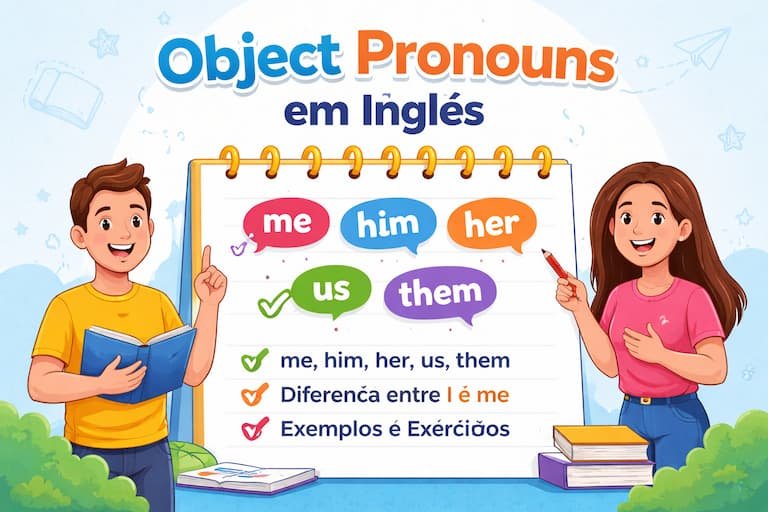
Introdução: Por Que Object Pronouns São Tão Importantes?
Se você quer falar inglês de forma natural, precisa dominar os object pronouns.
Eles aparecem o tempo todo em:
-
Conversas informais
-
Filmes e séries
-
E-mails
-
Mensagens
-
Entrevistas
-
Provas
Sem eles, seu inglês fica artificial ou incorreto.
Exemplo:
❌ I like Maria very much. Maria is very intelligent.
✅ I like Maria very much. She is very intelligent. I admire her.
Perceba como o uso correto dos pronomes evita repetição e deixa a frase natural.
O Que São Object Pronouns?
Object pronouns são pronomes que funcionam como objeto da frase — eles recebem a ação do verbo ou aparecem após uma preposição.
Eles substituem um substantivo.
Exemplo:
-
I saw John.
-
I saw him.
“John” vira “him”.
Tabela Completa: Subject vs Object
| Subject Pronoun | Object Pronoun |
|---|---|
| I | me |
| You | you |
| He | him |
| She | her |
| It | it |
| We | us |
| They | them |
Essa diferença é estrutural, não opcional.
Diferença Entre I e Me (Explicação Técnica)
1️⃣ I → Caso nominativo (sujeito)
Usado quando o pronome realiza a ação.
Exemplos:
-
I work here.
-
I understand the lesson.
-
I am learning English.
2️⃣ Me → Caso objetivo (objeto)
Usado quando o pronome recebe a ação.
Exemplos:
-
She called me.
-
They chose me.
-
He invited me to the party.
Estrutura Técnica
Frase padrão em inglês:
Sujeito + Verbo + Objeto
Exemplo:
She (sujeito) loves (verbo) him (objeto).
Regra de Ouro: Após Preposição, Use Objeto
Sempre que houver uma preposição, use object pronoun.
Preposições comuns:
-
to
-
for
-
with
-
about
-
from
-
between
-
without
-
after
-
before
Exemplos:
-
This is for me.
-
She went with him.
-
They talked about us.
-
The gift is from her.
-
It’s between you and me.
-
He left without them.
⚠️ Erro comum:
❌ between you and I
✅ between you and me
Object Pronouns em Perguntas
Eles aparecem normalmente após o verbo.
-
Do you know her?
-
Did they invite him?
-
Can you help us?
-
Have you seen them?
Object Pronouns com Verbos Frasais (Phrasal Verbs)
Aqui começa o nível avançado.
Quando usamos phrasal verbs separáveis, o object pronoun deve ficar no meio.
Exemplos:
Turn off the light.
Turn it off. ✅
❌ Turn off it.
Pick up the phone.
Pick it up. ✅
❌ Pick up it.
Bring back the book.
Bring it back. ✅
Essa regra é obrigatória.
Object Pronouns com Verbos + Dois Objetos
Alguns verbos permitem dois objetos:
-
Give
-
Tell
-
Send
-
Show
-
Offer
-
Bring
Estrutura 1:
She gave me the book.
Estrutura 2:
She gave the book to me.
Ambas corretas.
Mas com pronome, a forma direta é mais natural.
Uso em Ênfase (Informal)
Na fala informal, às vezes usamos object pronouns isolados.
Exemplo:
“Who did this?”
“Me.”
Formalmente, seria:
“I did.”
Mas na conversa informal, “Me.” é comum.
Object Pronouns com Gerúndio (-ing)
Após verbo + -ing, usamos object pronoun.
-
Thank you for helping me.
-
I appreciate you calling me.
-
She apologized for hurting him.
Object Pronouns com Infinitivo
-
I want you to help me.
-
She asked him to come early.
-
They told us to wait.
Casos Especiais
It como objeto impessoal
-
I like it.
-
I don’t understand it.
-
Can you fix it?
Object Pronouns após “let” e “make”
-
Let me explain.
-
Let him try.
-
Make her stop.
-
They made us wait.
Diferença Entre Her e Hers
Her pode ser:
-
Objeto → I like her.
-
Adjetivo possessivo → Her book is new.
Hers é pronome possessivo.
-
The book is hers.
Erros Frequentes de Brasileiros (Análise Profunda)
1️⃣ “Me and Ana”
❌ Me and Ana went to the party.
✅ Ana and I went to the party.
Porque é sujeito.
2️⃣ Uso excessivo de I
Brasileiros tendem a usar I após preposição.
❌ This is for I.
✅ This is for me.
3️⃣ Confusão com “us”
❌ She gave we a gift.
✅ She gave us a gift.
4️⃣ Confusão com “them”
❌ I like they.
✅ I like them.
Comparações Avançadas
Veja como o significado muda:
He saw her.
She saw him.
We invited them.
They invited us.
I trust him.
He trusts me.
A posição altera completamente o sentido.
Object Pronouns na Conversação Real
Expressões comuns:
-
Tell me about it.
-
Don’t tell me.
-
Give me a break.
-
Believe me.
-
Trust me.
-
Call me later.
-
Send me a message.
-
Help me out.
Essas estruturas são extremamente frequentes.
Exercícios Avançados
1) Complete corretamente:
a) She doesn’t like ___.
b) They invited ___ to the wedding.
c) The teacher explained it to ___.
d) I can’t find ___.
e) He sent ___ an email.
Respostas:
a) him/her
b) us
c) me
d) it
e) me
2) Corrija os erros:
a) This is between you and I.
b) Him is my best friend.
c) She gave we a present.
d) Me am ready.
Respostas:
a) between you and me
b) He is my best friend
c) She gave us a present
d) I am ready
Resumo Geral da Aula
Você aprendeu:
-
O que são object pronouns
-
Diferença estrutural entre I e me
-
Uso após verbos
-
Uso após preposições
-
Uso com phrasal verbs
-
Uso com dois objetos
-
Uso em estruturas avançadas
-
Erros comuns
Dominar object pronouns é um passo essencial para sair do nível iniciante e entrar no nível intermediário.
Próxima Aula
Na próxima aula você aprenderá:
Possessive Adjectives e Possessive Pronouns (my, mine, your, yours…)
E entenderá a diferença entre:
-
her
-
hers
-
their
-
theirs